Mental Health In Teens - How Common Is It and How To Help!

ADvTECH Group • February 14, 2022

Your Teen’s Mental Health
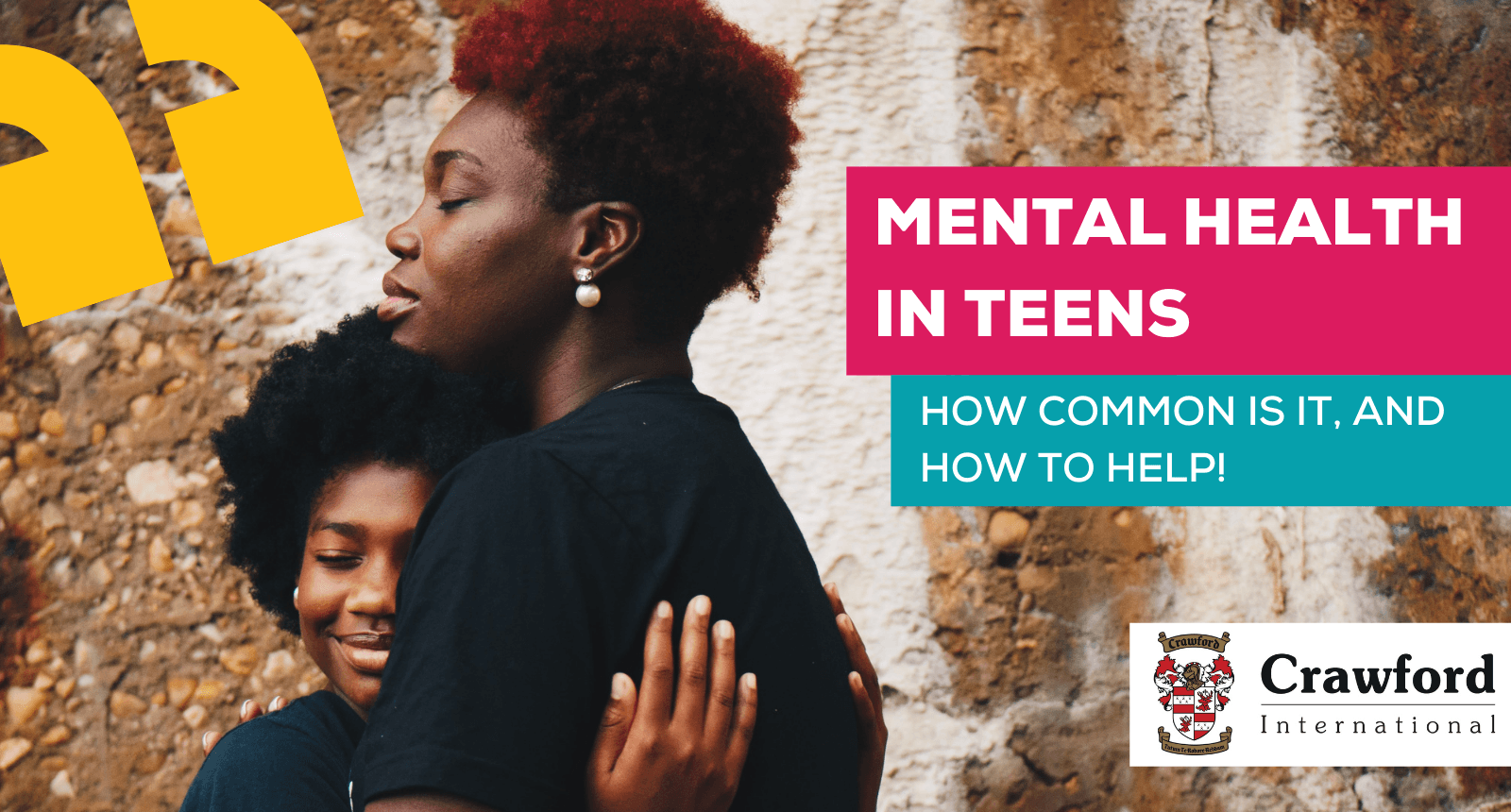
A poster for mental health in teens shows two women hugging each other

When is it time to worry about a moody teenager? Teen mental health is a growing concern for many parents, so read on to find out what to look out for and how to help.


The World Health Organization says that when it comes to teens aged 15 to 19 years, depression is the fourth leading cause of illness, and anxiety the ninth leading cause of illness in the age group. What’s more, around half of mental health conditions start by the of 14, but most go undetected and untreated, they say. So, what’s going on with our young adults and how do we know if it is just normal teenage behaviour or if there is something more at play?


Read about Crawford International's holistic approach to education here.


The Teenage Brain


Besides toddlerhood, adolescence is a period of life that sees the most brain development. The dynamic changes that are happening in the brain at this time make this an important phase that helps to set the scene for how your teen thinks, acts and feels – the experiences they have now affect how their brains develop, so it’s worth thinking about how the things your teenager is into are shaping his brain for adulthood.


Probably the biggest thing to bear in mind here is that the prefrontal cortex is still developing in a teenager. This is the part of the brain that controls decision making, and this affects your child’s ability to plan and think about the consequences of their actions, solve problems and control impulses. To make up for this, their brains rely on the amygdala for these tasks.


The problem here is that the amygdala is associated with emotions, aggression, impulses and instinctive behaviour. What this boils down to is that your almost-adult child seems to behave remarkably maturely at times, but behaves impulsively, illogically and emotionally at others.


You may also notice that your teen’s sleep patterns have changed, which are also a result of this brain development. They tend to stay up late at night and struggle to get up in the morning, and lack of sleep also affects their moods, attention spans and impulsivity. These shifts are quite normal in teens.


Mental Health In Teenagers


However, sometimes a teenager’s moods are more than this. Mental health struggles, such as teen anxiety and depression, go beyond fatigue and feeling lonely, angry and frustrated. They are longer lasting and more severe and affect a teen’s usual way of thinking, acting and feeling, and impact daily life.


When it comes to teen mental health, there are a lot of things at play. The more risk factors they experience, the more likely an impact on their mental health. These stressors can include peer pressure, experiencing disappointments or conflict, exposure to violence, instability at home, socio-economic struggles, as well as exploring self-identity. There are the added influences of media and gender norms that can also affect how your teen sees the world and themselves.


This is why developing positive daily habits now are key, such as exercising regularly; developing emotional resilience that can help with managing emotions, developing coping skills and problem-solving; and learning interpersonal skills to interact with others well. A protective home environment that offers unequivocal support is also vital.


What To Look Out For


Remember that your teenager is carving out an individual identity for themselves, and they may experiment when trying to define themselves. A flux in hairstyles, clothes, even values and ideas are normal. But destructive and repeatedly inappropriate behaviour could signal deeper problems. If you’re worried about your teen’s mental health, keep an eye out for these:

  • A low mood that does not go away, including ongoing feelings of hopelessness or sadness without a definable cause.
  • Low self-esteem or self-blame.
  • An unexpected and extreme decline in academic performance, skipping school, or teacher has noticed issues at school.
  • Drastic changes in sleep – teens should get 9 to 10 hours of sleep a day, sleeping far too much or too little, as well as insomnia, could be red flags.
  • Changes in eating habits – eating more or far less than normal.
  • Outbursts of anger, with increased irritability, frustration or agitation.
  • Unexpected tearfulness or feelings of hopelessness and worthlessness.
  • Withdrawing from the world – abandoning favourite pastimes, losing interest in things, actively isolating from friends and family.
  • A loss of interest in appearance.
  • Physical symptoms like headaches, nausea, stomach pains and other pain that don’t go away when treated.
  • Substance abuse (alcohol or drugs) and other risky behaviours.
  • Talking about harming themselves, death and suicide – seek immediate professional help.


How You Can Help


It can be difficult to distinguish typical teenage behaviour from warning signs of an underlying problem. So, the biggest way you can help your teen is to familiarise yourself with the signs of mental health conditions, provide an environment of open and honest communication, and ensure a solid support system exists.


  • Listen, don’t lecture:


When you talk to your teenager, try to do so without judgement. Bring up your concerns and try not to judge or criticise your teenager when they open up and talk to you – what’s important is that they are communicating with you.


  • Their feelings are all valid:


What your teenager is feeling and experiencing is very real to them, even if you think their concerns are trivial. Acknowledge their feelings and give them the room to experience them – you can’t talk anyone out of depression, but support and knowing that they are believed mean the world.


  • Persist gently:


Think back to your teen years – probably the last thing you wanted to do was bare your soul to your parents. Talking about their feelings is tough, so don’t give up if your child shuts you down at first. Keep opening up the channels of communication, they’ll appreciate knowing you’re there.


  • Provide opportunities for engagement:


Help your teen stay connected to others and their passions. Encourage them to invite their friends over, help make it easier to engage in their hobbies, etc.


  • Listen to your parent heart:


Trust your instincts. You know your child best, and if you are worried about your teenager’s behaviour then look into it even if they claim nothing is wrong.


  • Get help from the pros:


Your GP should be able to refer you to a counsellor, psychologist or psychiatrist in your area. The South African Depression and Anxiety Group (SADAG) is also a great resource for information, tools and support, as well as numbers for various helplines, visit them at sadag.org


Sometimes, even with the most supportive environment, the most engaged parents, the best open communication and greatest love, a teen struggles. Teen anxiety and depression, eating disorders, and other mental health issues are not a sign of weakness, nor can they be dealt with using positive thinking or willpower. Should you suspect a mental health issue, seek help from a mental health professional sooner rather than later. 


Read more parenting advice articles here.

June 12, 2026
When Leah Mari matriculated from Crawford International La Lucia College in 2019, she already had a passion for music, performance and storytelling. Today, she is one of South Africa's most exciting young performers, building an impressive career across musical theatre, film and music. A graduate of the Luitingh Alexander Musical Theatre Academy (LAMTA) in Cape Town, Leah has quickly earned recognition for her talent and dedication. Following her graduation at the academy, she received a nomination for the Fleur du Cap Theatre Award for Most Promising Student in 2024, highlighting her emergence as a rising star in the performing arts industry. Born and raised in Durban, Leah's creative journey began long before she stepped onto professional stages. A singer, pianist and emerging composer, she recorded her first EP whilst doing Grade 9 in 2016 and was a member and soloist of the KwaZulu-Natal Youth Choir. In 2019, she was awarded the prestigious DALRO ACT Scholarship, further supporting her pursuit of a career in the arts. In 2021, Leah was one of two winners of the national Cabaret and Beyond Songwriting Festival. The achievement led to the creation of her original one-act musical, Call Me A Fool, which was produced in association with The Centre for Creative Arts and staged in both Gqeberha and Durban in 2022 under the direction of Steven Stead. A second production followed later that year in collaboration with LAMTA. During her studies, Leah performed in a number of theatre and musical theatre productions at Theatre on the Bay and Pieter Toerien's Montecasino Theatre. Her credits included roles in Mephisto, The Seagull and Cosi, as well as several original South African productions including All Together Now, Come Together and Being Steve. Leah made her professional debut as the alternate Maria in Pieter Toerien and Cape Town Opera's production of The Sound of Music in 2023 and 2024. She followed this with a role in the South African premiere of Stephen Sondheim's Company in 2024. Her breakthrough came when she was cast as Eliza Doolittle in My Fair Lady. Her acclaimed performance earned her both a Fleur du Cap Theatre Award and a Naledi Theatre Award for Best Performance by a Lead Actress in a Musical, cementing her place as one of the country's leading young musical theatre performers. In 2025, Leah expanded her career into film, making her feature film debut as Meera in Lucky Fish. She also appeared in several short films, including Gangsters Tea and At Horizon's End, showcasing her versatility as a performer across different mediums. Most recently, audiences have seen Leah on stage in Chicago: The Musical and Pretty Woman: The Musical. It has also been announced that she will take on the role of Sophie Sheridan in the highly anticipated return of MAMMA MIA!, adding another iconic character to her growing list of achievements. Leah’s journey from Crawford International La Lucia College to award-winning performer highlights how Crawford empowers global leaders to thrive on the world stage. Her success continues to inspire current Crawford students to pursue their ambitions with confidence and creativity. As her career continues to flourish on stages and screens locally and internationally, Leah remains a shining example of what can be achieved when talent is nurtured and dreams are pursued with determination.
June 5, 2026
As children progress through primary school, they learn significantly more than academic knowledge. They learn to plan, to attend, to recall instructions, to control their emotions, and to adjust to new situations. These important skills are called executive function skills, and they are key to a child’s performance in school and in life. Executive function skills are typically called the brain’s management system. They assist children to structure their thinking, regulate their conduct and carry out tasks in an efficient manner. These skills develop naturally over time, but parents can play a vital role in nurturing and strengthening them throughout childhood. Understanding how executive function skills develop can help parents create opportunities at home that encourage independence, resilience, and lifelong learning. What Are Executive Function Skills? Executive function skills are a set of mental processes that allow children to process their thoughts, actions, and emotions in pursuit of a goal. These skills help children: Focus attention Follow instructions Solve problems Control impulses Organise tasks and belongings Manage emotions Adapt to change Executive functioning is particularly important during the primary school years, when children face increasing academic and social demands. The Three Core Executive Function Skills Although executive functioning involves many interconnected abilities, three core skills form its foundation. Working Memory One of the most important aspects of executive functioning is working memory and inhibition . Working memory allows children to hold information in their minds while using it to complete a task. For example, a learner may need to remember a teacher's instructions while completing an activity or keep track of multiple steps when solving a maths problem. Strong working memory helps children: Follow multi-step instructions Complete classroom activities independently Retain and apply new information Improve reading comprehension Solve complex problems Inhibitory Control Inhibition refers to the ability to pause, think, and control impulses before acting. Children use inhibitory control when they: Wait their turn Stay focused despite distractions Follow classroom rules Manage emotional reactions Think before speaking Developing inhibition helps children build self-regulation and positive social relationships. Cognitive Flexibility Cognitive flexibility enables children to adjust their thinking when circumstances change. This skill allows learners to: Adapt to new situations Consider different perspectives Solve problems creatively Learn from mistakes Transition between activities more easily Together, these executive function skills support the development of broader cognitive skills in children and contribute to overall academic success. Why Executive Function Skills Matter During Primary School Development Executive function skills become increasingly important as children move through primary school. Academic expectations grow each year, requiring learners to: Manage homework responsibilities Organise school materials Work independently Collaborate with peers Complete long-term projects Manage time effectively Children who have well-developed executive function skills are often better equipped to cope with these demands. They are more likely to stay focused, recover from setbacks, and approach challenges with confidence. Executive functioning also supports emotional wellbeing. Children who can regulate their emotions and behaviour are better able to navigate friendships, resolve conflicts, and respond positively to challenges. For this reason, executive functioning is a key component of healthy primary school development . How Parents Can Support Executive Function Skills at Home The good news is that executive function skills can be strengthened through everyday experiences. Parents have countless opportunities to nurture these abilities at home. Establish Consistent Routines Predictable routines help children develop organisation and self-management skills. Visual schedules and checklists can be particularly helpful for younger children. Encourage Planning and Organisation Provide opportunities for children to take ownership of their responsibilities. Rather than solving problems for children, guide them through the planning process. Strengthen Working Memory Simple activities can help improve working memory, such as, memory games, cooking together, learning songs or poems and retelling stories. These activities provide opportunities to practise holding and using information. Build Inhibitory Control Through Play Many childhood games naturally strengthen inhibition and self-control. Encourage Problem-Solving When children encounter challenges, encourage them to think through possible solutions. By ask questions such as: What is the problem? What could you do differently? This approach develops both cognitive flexibility and independent thinking. Support Emotional Regulation Parents can help children manage emotions by naming and discussing feelings, modelling calm responses, encouraging reflection and teaching coping strategies. Promote Independence Allow children to take responsibility for age-appropriate tasks such as, organising school materials and completing chores. Encourage Physical Activity Regular physical activity supports brain development and executive functioning. Supporting Lifelong Success Executive function skills are not only important for academic achievement. They also influence how children manage relationships, solve problems, make decisions, and respond to challenges throughout life. In Conclusion Executive function skills are among the most important abilities children develop during their primary school years. From working memory and inhibition to organisation, self-regulation, and problem-solving, these skills form the foundation for learning, emotional wellbeing, and independence.
May 29, 2026
25 years of science, curiosity and community Fromplant physiology to the physics classroom, a career built on wonder. From the laboratory to the classroom After completing a master’s degree in Plant Physiology and Biochemistry from the University of KwaZulu Natal in 1990, a six-month lecturing stint quickly gave way to an unexpected opportunity: Ms Visser, a locum teaching position at George Campbell Technical High School. It turned out to be a defining moment. Recognising that teaching was a true calling, a Diploma in Higher Education from UNISA followed in 1995, formalising a commitment to the profession. A family connection to Crawford International La Lucia January 2000 marked the beginning of an extraordinary chapter at Crawford International La Lucia, joining the school the same month that the oldest of two sons started Grade 000. Both boys went on to complete their full 15 years of schooling at the school, a journey their father witnessed firsthand from the other side of the classroom. “Both our sons completed 15 years of schooling at Crawford International La Lucia, and they are truly grateful for the opportunity to have attended this incredible school.” Subjects and philosophy Over the years, Physical Sciences, Life Sciences, Technology and Further Studies Physics have all featured in her timetable. Across every subject, the goal has remained constant: to develop independent thinkers and well-balanced individuals with a natural curiosity and wonder for the world around them. What makes Crawford International La Lucia special The classroom has been the source of some of the happiest memories, with the energy students bring, their genuine interest, and their willingness to contribute meaningfully to every lesson. Equally treasured are the colleagues encountered along the way: dedicated, talented professionals whom it has been a privilege to work alongside, many of whom have become lasting friends. She says, “I love the energy and interest that our students display and their willingness to contribute meaningfully to lessons.” Looking back on more than two decades at Crawford International La Lucia, the years have been fun-filled, busy and deeply rewarding, a proud part of the school’s history. Fun Facts At Crawford International La Lucia since: January 2000 Qualifications: MSc Plant Physiology & Biochemistry (UKZN), Diploma in Higher Education (UNISA) Subjects taught: Physical Sciences, Life Sciences, Technology, Further Studies Physics Teaching philosophy: Independent thinkers with a natural curiosity for the world
May 22, 2026
When Rafie Mehrji Manshadi walked out of Crawford International College Sandton in 2018 with seven distinctions and his Student Prefect badge, he had no conventional road map for what came next. Today, he is a certified AI specialist, enterprise consultant, and co-founder of Angel Enterprise - a multi-division business ecosystem spanning AI consulting, creative design, hospitality, promotions, and education. His journey has been anything but linear. After matriculating at Crawford, Rafie pursued a Bachelor of Optometry at the University of Johannesburg, completing his degree in 2023. But throughout those four years, one thing never left him: a deep fascination with technology and artificial intelligence. Where others saw a completed degree as a destination, Rafie saw a crossroads. He made the bold decision to step away from optometry entirely and pursue the field that had always captivated him most. "It was a challenge to deal with the fact that I spent four years studying and then completely changed direction," he reflects. "But I was never happy with the conventional path - study, get a degree, get a job. I knew I didn't want to be an employee. I wanted to build something." And build he did. At the heart of Angel Enterprise sits Angel Intelligence, Rafie's primary focus - helping organisations move from AI experimentation to genuine, measurable impact through consulting, workflow automation, and AI system engineering. Beyond that, the broader ecosystem delivers branding, hospitality staffing, promotional services, and structured AI education programmes, all operating under one cohesive vision. Holding certifications from the Dubai Centre for AI, IBM, Anthropic, and Yale University, Rafie brings rare technical depth to a field reshaping every industry. His Crawford years, he says, gave him something no curriculum can fully teach. "Crawford showed me how to be myself - and that if I don't see a path for me, I should create my own." That instinct - to build rather than follow - is precisely what Crawford has always nurtured. And in Rafie Mehrji Manshadi, Sandton College has an alumnus who embodies it completely.
May 8, 2026
With 15 years at Crawford International Sandton Pre-Primary and a career dedicated to supporting young students who need a little extra encouragement, Ms Goldberg brings patience and deep professional expertise to her role as a Learning Support Teacher. For the children in her care, her classroom is a place where it is safe to try and safe to grow. The Road to Teaching Ms Goldberg has spent her entire teaching career at Crawford International Sandton, where she has built a reputation as a trusted and deeply committed member of the learning support team. Over 15 years, she has worked closely with Grade 0 students, focusing on small-group intervention that meets children where they are and gently guides them forward. Her passion for supporting students who find certain areas of learning more challenging has been a consistent thread throughout her time at Crawford, shaping both her approach in the classroom and the relationships she builds with the children and families she serves. Qualifications and Expertise Ms Goldberg's qualifications focus on early childhood and inclusive education. She holds a Higher Diploma in Pre-Primary and Junior Primary Education, which laid a strong foundation in understanding how young children develop and learn. She furthered her expertise with a B. Ed Honours degree in Learning Support, equipping her with the specialist knowledge required to identify and address the diverse needs of students in the foundation phase. This combination of early years training and focused learning support expertise has proven to be one of her uniqueness in the classroom, providing targeted intervention for the youngest members of our Crawford community. Teaching Philosophy At the core of Ms Goldberg's practice is a belief that every child is capable, plus that the environment in which they learn makes all the difference. She is guided by patience and a deep respect for the fact that no two children learn in exactly the same way. Creating a space where students feel genuinely safe, safe enough to take risks, make mistakes and keep going, is not incidental to her teaching. It is the foundation of it. For Ms Goldberg, building academic skills and building self-belief are not separate goals. They grow together, and both deserve equal attention and care. "My teaching philosophy is centred on patience, encouragement and understanding that every child learns differently. I believe in creating a safe and supportive environment where students feel confident to try, make mistakes and grow. My goal is to help each child build both their skills and their self-belief." What Ms Goldberg Values About Crawford For Ms Goldberg, Crawford International Sandton is more than a place of work. It is a community she has been part of for over a decade and a half. "My colleagues are like family, and we share a very close and supportive environment. Being part of such a strong team makes my work even more meaningful." This sense of belonging and shared purpose is something she carries into her classroom, creating the same spirit of care and mutual support for the students in her groups that she herself experiences among her peers. Beyond the Classroom Outside of school, Ms Goldberg is a proud mom to three teenage boys, a full and lively household by any measure. She finds balance and energy through regular gym sessions, long walks with her dogs and a well-deserved cup of coffee. These small, grounding rituals reminds us of the same intentionality and warmth she brings to her professional life. Quick Facts: 15 years at Crawford International Sandton Role: Learning Support Teacher, Grade 0 (small group intervention) Qualifications: Higher Diploma in Pre-Primary and Junior Primary Education and B.Ed Honours in Learning Support Passionate about building confidence and self-belief in young students Mom to three teenage boys Enjoys coffee, the gym and walking her dogs
Crawford International text on white background: “Choosing the Right Private School in South Africa”
April 17, 2026
A practical guide for parents on choosing the right private school in South Africa, from academics and culture to costs and location.
March 27, 2026
Meet Natasha Pillay: Nurturing Potential at Crawford International Fourways With nearly three decades in education and 14 years at Crawford International, Ms Pillay brings a unique blend of academic rigour, lived experience and heartfelt purpose to every classroom. Guided by a belief that every child can thrive when they feel truly valued, she continues to inspire students through inclusion and genuine care. The Road to Teaching Ms Pillay's teaching career spanning close to 30 years began in 1998 with the KwaZulu-Natal Department of Education, before extending internationally with a stint in the United Kingdom. This breadth of experience has shaped a grounded, versatile approach to education that draws on both local and global perspectives. The foundation was laid at Springfield Teaching College, where a first-principles approach to teaching was instilled, one that continues to inform her classroom practice today. Since joining Crawford International on 28 May 2012, Ms Pillay has become a trusted and valued member of the community, approaching the end of her 14th year at the school. Qualifications and Subjects Taught A commitment to lifelong learning is evident in Ms Pillay's impressive academic record. Alongside the foundational diploma from Springfield Teaching College, her qualifications include a B Comm degree majoring in Financial Management, completed in 2006, and a B Ed Honours degree majoring in Inclusive Education, completed in 2012. The focus on inclusive education speaks directly to a deeply held belief in the right of every student to access meaningful, supportive learning. Teaching Philosophy At the heart of Ms Pillay's approach is a simple but powerful conviction: that every child can reach their full potential when they feel supported and valued. "I aim to create a safe, inclusive space where students feel confident to take risks and explore new concepts. Seeing my students grow, take initiative and discover their strengths motivates me every day as a teacher." This philosophy is not merely aspirational. It is lived out in the daily rhythms of the classroom, where safety is treated as a prerequisite for academic growth and where each student is encouraged to believe in their own ability. What Ms Pillay Values About Teaching at Crawford The curiosity and unique perspectives of Crawford's students are what make each day inspiring. Whether asking unexpected questions, approaching problems from fresh angles, or challenging themselves to grow, these students bring energy and authenticity to the learning environment. Working within the framework of the IB philosophy has deepened Ms Pillay's own practice as a teacher and reinforced a commitment to continued learning alongside her students. Crawford International is seen not simply as a place of employment, but as a community of shared values and shared growth. Beyond the Classroom Outside of school, Ms Pillay finds joy in cooking hearty meals for a son currently studying Engineering at university. Weekends often include hiking trails at Hennops, where the outdoors offers space for reflection and renewal. In recent years, a personal journey toward greater spiritual awareness has also taken shape, through reading, visiting places of spiritual significance and the practice of meditation. It is a pursuit that speaks to the same values she brings into the classroom each day: intentionality, openness and a desire to keep growing. Quick facts Joined Crawford International on 28 May 2012, completing 14 years at the end of May 2026 Teaching career began in 1998 with the KwaZulu-Natal Department of Education Also taught in the United Kingdom Qualifications: Springfield Teaching College Diploma · B Comm in Financial Management (2006) · B Ed Honours in Inclusive Education (2012) Enjoys hiking at Hennops, cooking and spiritual development through reading and meditation Proud parent of a son studying Engineering at university
Text reads
March 20, 2026
Explore the science behind play-based learning and how it shapes children's cognitive development — from memory and attention to creativity and executive function.
March 13, 2026
Ms van Straaten is a passionate early years teacher who believes the foundation for a child’s lifelong love of learning is built in the earliest stages of schooling. Recently stepping into her role as a Grade 0 teacher at Crawford International Bryanston, she brings warmth, insight and experience to her classroom, creating an environment where young students feel safe, valued and ready to explore. The Road to Teaching Ms van Straaten holds a BEd degree in Psychology and Human Resource Management, as well as a PGCE in the Foundation Phase. Her background in psychology informs her understanding of child development and emotional well-being. She began her teaching career as a Grade 000 teacher, where she spent three years helping young children build strong early foundations. During this time, she developed a deep appreciation for the importance of play, secure relationships and responsive teaching in the formative years. Her move into Grade 0 marks an exciting next step as she continues guiding students through important developmental milestones. Subjects and Focus As a Grade 0 teacher within an IB framework, Ms van Straaten supports learning through a play based, inquiry driven approach aligned with the Primary Years Programme. She guides students through early literacy and numeracy development while also supporting their social, emotional and creative growth. Through carefully planned learning experiences, she encourages curiosity, independence and holistic development. Teaching Philosophy Ms van Straaten takes a holistic approach to learning. She believes emotional wellbeing is central to academic progress and prioritises creating a classroom where children feel secure, understood and confident to take risks. “In the early years, children are developing far more than academic skills. They are building confidence, learning how to express themselves and beginning to understand the world around them. At Crawford International Bryanston, I believe it is important that every child feels safe, supported and encouraged to explore. When students feel emotionally secure, they are more open to learning, collaboration and growth,” shares Ms van Straaten. What She Values About Teaching Ms van Straaten finds great fulfilment in witnessing the transformation that happens during the early years, from developing confidence and independence to celebrating meaningful developmental milestones. Working with young children continues to inspire her daily and she remains committed to nurturing not only their academic readiness, but also their emotional and social development within the Crawford community.
March 6, 2026
In a significant recognition of its leadership in sustainable education, ADvTECH - Africa's leading private education provider - has been honoured for exceptional environmental stewardship at the Wildlife and Environment Society of South Africa (WESSA) Centenary Awards. Celebrating a century of inspiring environmental action, education, and advocacy under the motto “People Caring for the Earth”, WESSA acknowledged ADvTECH's deep integration of the Eco-Schools South Africa programme for its unparalleled scale and impact. “As WESSA marks 100 years of environmental leadership, partnerships like the one we share with ADvTECH remind us why environmental education remains one of the most powerful tools for long-term change,” says WESSA CEO Cindy-Lee Cloete.  “When 42 schools within a single education group commit to environmental stewardship, the ripple effect extends far beyond the classroom into homes, communities and ultimately into the future leadership of this country.” At the awards ceremony on February 27, 37 ADvTECH schools received Silver Awards status, which celebrates two years of WESSA collaboration, and the schools below have shown their lasting dedication by participating in environmental initiatives and raising awareness. Trinityhouse, Little Falls: Gold status (4 yrs.) Crawford International School, Sandton: Platinum 2 status (7 yrs.) Tyger Valley College: Bronze Decade status (12 yrs.) Pinnacle College, Ridgeview: Green Flag Decade status (13 yrs.) Pecanwood College: Platinum Decade 2 status (17 yrs.) Additionally, also recognised for submitting the most eco-snippets All of the ADvTECH participating schools achieved full assessment letters for their submitted portfolios of evidence, with scores ranging from 70% - 98%. Top achieving schools were: Crawford International School, La Lucia Maragon Olympus, Faerie Glen Crawford International School, Sandton Crawford International School, Lonehill Abbots College, Northcliff Additionally, ADvTECH received a Partnership Award in recognition of its outstanding and unique contribution to environmental stewardship. “It has been another incredible year working closely with the WESSA champions at our schools, as well as the dedicated WESSA team. Throughout 2025, we witnessed some of the most inspiring and comprehensive portfolios of evidence ever submitted, reflecting not only commitment but also genuine passion for environmental stewardship and sustainability. The quality, creativity, and consistency demonstrated by our champions have set a remarkable standard and continue to inspire positive change within their school communities,” says Krystal Munian, Academic Advisor and WESSA Lead. “We extend our sincere gratitude to every champion and the school teams for their phenomenal hard work, perseverance, and dedication to advancing the project’s goals. And we are excited about the year ahead and look forward to building on this momentum through new activities, innovative initiatives, collaborative projects, and continued growth across all participating schools.”
Show More